

Industrial automation is designed to improve efficiency, consistency, and safety. However, when systems fail, the consequences can be immediate and costly. These include unplanned downtime, production losses, and safety risks.
For manufacturers in Malaysia, many of these failures are preventable. With the right PLC control system, businesses can reduce disruptions and maintain stable operations. This guide explores the most common automation failures and how PLC systems help prevent them.
Why Industrial Automation Failures Happen
Automation systems involve multiple components such as sensors, actuators, control panels, wiring, and software. A failure in any one area can affect the entire production line.
Common root causes include:
- Poor system design or outdated control architecture
- Lack of preventive maintenance
- Electrical faults or unstable power supply
- Human error in manual processes
- Inadequate monitoring and diagnostics
Without a centralised and intelligent control system, identifying and resolving these issues becomes difficult.
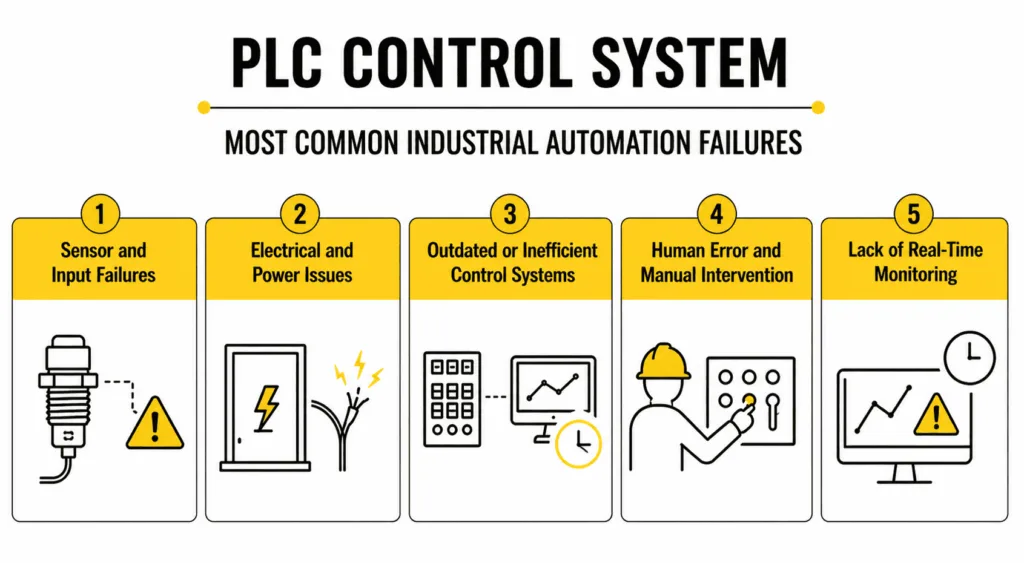
Most Common Industrial Automation Failures
1. Sensor and Input Failures
Sensors provide critical data to control systems. When they malfunction, machines may receive incorrect signals, leading to defective output or unexpected shutdowns.
Impact:
- Inconsistent product quality
- Process interruptions
- Increased waste
2. Electrical and Power Issues
Voltage fluctuations, short circuits, or poor wiring can cause sudden system failures. These are especially common in older facilities without proper electrical control systems.
Impact:
- Equipment damage
- Frequent downtime
- Safety hazards
3. Outdated or Inefficient Control Systems
Traditional relay-based systems or legacy automation setups lack flexibility and real-time monitoring capabilities.
Impact:
- Slow troubleshooting
- Limited scalability
- Higher maintenance costs
4. Human Error and Manual Intervention
Manual overrides or incorrect operation can disrupt automated processes, especially in complex production environments.
Impact:
- Process inconsistencies
- Increased risk of accidents
- Reduced efficiency
5. Lack of Real-Time Monitoring
Without proper visibility into operations, small issues can escalate into major failures before they are detected.
Impact:
- Delayed response times
- Unexpected breakdowns
- Higher repair costs
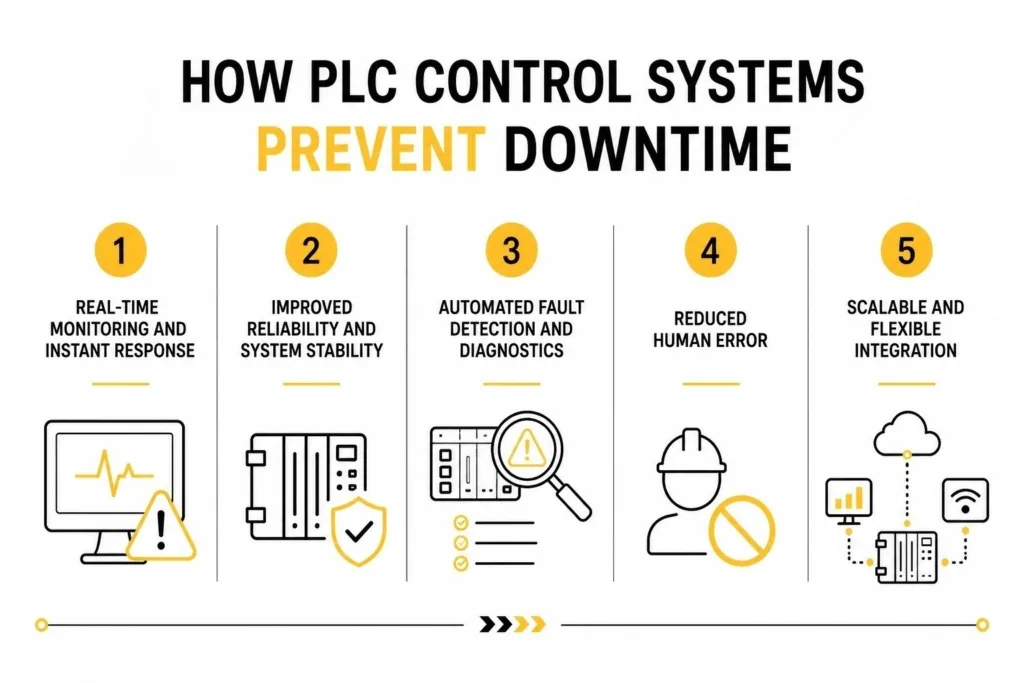
How PLC Control Systems Prevent Downtime
A PLC control system acts as the brain of industrial automation. It continuously monitors inputs, processes logic, and controls outputs in real time, ensuring stable and efficient operations.
1. Real-Time Monitoring and Instant Response
PLC systems detect abnormalities immediately and trigger corrective actions or alarms. This reduces the time between fault detection and resolution.
2. Improved Reliability and System Stability
Modern PLCs are designed for industrial environments. They offer high durability and resistance to electrical noise, temperature variations, and harsh conditions.
3. Automated Fault Detection and Diagnostics
Advanced PLC systems provide detailed diagnostics. This helps engineers quickly identify the root cause of issues without extensive manual inspection.
4. Reduced Human Error
By automating critical processes, PLC systems minimise reliance on manual intervention. This reduces the risk of operational mistakes.
5. Scalable and Flexible Integration
PLC systems can be integrated with SCADA, IoT, and other smart technologies. This allows businesses to scale operations and improve efficiency over time.
PLC Control Systems vs Traditional Control Systems
| Feature | PLC Control System | Traditional Relay System |
|---|---|---|
| Flexibility | Easily programmable and scalable | Difficult to modify once installed |
| Troubleshooting | Real-time diagnostics and alerts | Manual fault detection required |
| Downtime Risk | Low due to automated monitoring | Higher due to delayed issue detection |
| Maintenance | Easier and more efficient | Frequent and time-consuming |
| Integration | Supports SCADA, IoT, and modern systems | Limited or no integration capability |
| Accuracy | High precision control | Prone to human and mechanical errors |
| Long-Term Cost | Lower due to efficiency and reliability | Higher due to maintenance and downtime |
Benefits of Implementing PLC Systems in Malaysia
For local manufacturers, investing in a reliable PLC control system in Malaysia offers several advantages:
- Reduced unplanned downtime
- Improved production efficiency
- Better compliance with safety standards
- Lower long-term maintenance costs
- Enhanced data visibility and control
Industries such as manufacturing, food processing, and oil and gas are increasingly adopting PLC automation to stay competitive.
Choosing the Right PLC Control System Provider
Not all PLC solutions are the same. A well-designed system requires engineering expertise, industry knowledge, and reliable support.
When selecting a provider, consider:
- Experience in industrial automation and control systems
- Customisation capabilities based on your operations
- Proven track record and project portfolio
- After-sales support and maintenance services
Working with an experienced provider ensures your system is designed for performance, reliability, and long-term scalability.
Why Choose ACT Industries Equipment
At ACT Industries Equipment, we deliver reliable PLC control system solutions tailored to real industrial requirements. Our focus is on engineering quality, practical implementation, and long-term system performance.
We understand the challenges manufacturers face in Malaysia, including downtime, inefficiency, and complex automation needs. Every solution is designed to improve stability, reduce maintenance issues, and support consistent productivity.
What Sets Us Apart
- Experienced in industrial automation and control system integration
- Custom PLC solutions tailored to your production needs
- Strong focus on reliability, safety, and efficiency
- End-to-end support from design to installation and commissioning
- Commitment to reducing downtime and improving performance
Reduce Downtime with Reliable PLC Control Systems
Upgrade your automation setup with a PLC solution designed to improve stability, efficiency, and long-term performance for your operations in Malaysia.
Conclusion
Industrial automation failures can disrupt operations and impact profitability, but they are largely preventable. By implementing a robust PLC control system in Malaysia, businesses can gain better control, improve reliability, and minimise downtime.
As industries in Malaysia continue to modernise, adopting advanced PLC automation is essential for sustainable growth and operational excellence.
Frequently Asked Questions (FAQs)
How much does a PLC control system cost in Malaysia?
The cost depends on system complexity, number of I/O points, hardware brand, and level of customisation. Small systems may cost a few thousand ringgit, while fully integrated industrial automation systems can range significantly higher. A proper site assessment is usually required for an accurate quote.
How long does it take to install a PLC control system?
Installation timelines vary based on project scope. Simple control panels can be completed within a few weeks, while larger automation projects involving design, programming, testing, and commissioning may take several months.
Can a PLC system be integrated with my existing machines?
Yes, most PLC systems can be integrated with existing machinery. However, compatibility depends on the current setup, communication protocols, and condition of your equipment. An evaluation is needed to determine the best integration approach.
What are the signs that my factory needs a PLC upgrade?
Common signs include frequent downtime, difficulty troubleshooting issues, outdated relay-based systems, inconsistent production quality, and lack of real-time monitoring. If maintenance costs are increasing, it may be time to upgrade.
Do PLC systems require regular maintenance?
Yes, regular maintenance is important to ensure reliability. This includes checking wiring, updating software, inspecting components, and monitoring system performance. Preventive maintenance helps avoid unexpected failures and extends system lifespan.